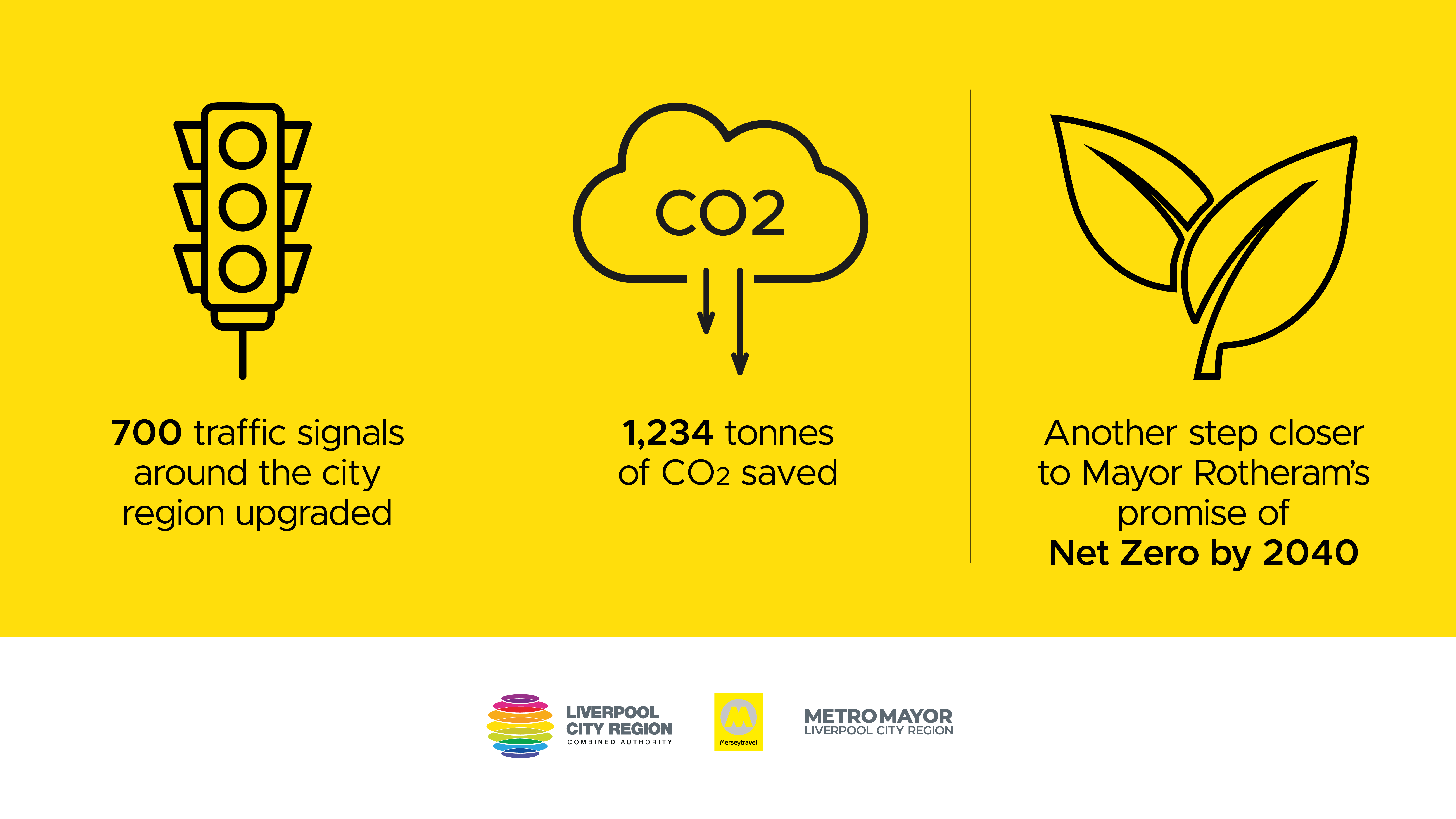
- £8.3m “spend to save” investment
- 700 traffic signal sites around city region upgraded
- 1,234 tonnes of CO₂ saved
- Another step closer to Mayor Rotheram’s promise of Net Zero by 2040
A major LED traffic signals project has delivered more than 1,200 tonnes in carbon savings for the Liverpool City Region
The Combined Authority, together with city region local authorities, has successfully completed a major programme to retrofit and upgrade traffic signals across the region’s roads, delivering 1,234 tonnes of CO₂ reductions, energy savings, reduced future maintenance and road safety benefits while future-proofing critical transport infrastructure.
Completed at the end of last year, the LED Traffic Signals Upgrade saw around 700 traffic signal sites upgraded from outdated halogen technology to modern, energy-efficient LED signals. The programme – a key part of the Liverpool City Region’s Pathway to Net Zero – directly supports the Mayor’s commitment to making the city region carbon neutral by 2035.
Councillor Steve Foulkes, Chair of Liverpool City Region Transport Committee, said:
“This project shows exactly how tackling the climate emergency can go hand in hand with making people’s lives better. By upgrading hundreds of traffic signals across our city region, we’re cutting carbon, saving hundreds of thousands of pounds in energy costs every year, and making our roads safer and more reliable.
“It’s a smart, practical investment that future-proofs vital infrastructure, delivers real value for taxpayers, and helps us move faster towards our goal of a net zero Liverpool City Region. This is the kind of joined-up action we need to see more of as we build a cleaner, fairer and more sustainable future.”
Designed to modernise aging infrastructure while minimising waste and maximising value for money, the LED traffic signals retrofit replaced the individual aspects of the signal heads at a site, wherever possible, rather than replacing complete heads, reducing material use and supporting recycling.
Based on the completed works, the project is delivering annual savings of:
- 1,234 tonnes of CO₂
- 28 million kWh of energy
- £684,000 per year in energy costs, based on current electricity prices
In addition to environmental benefits, the upgrade supports the Liverpool City Region’s Road Safety Strategy – Vision Zero, with LED signals providing improved visibility through modern lens technology and significantly reduced failure rates.
The project has recently been shortlisted for an award at the Decarbonising Transport Awards taking place in London in March.